Whisperai

Speech to text

Whisper vs Transcribe for Real-World Audio

The right speech-to-text engine depends on more than a transcript. Compare whisper vs transcribe across control, deployment, language coverage, workflow effort, and operational fit before you switch.

5
core Whisper model sizes
99+
languages supported by Whisper
2
core tasks: transcription and translation
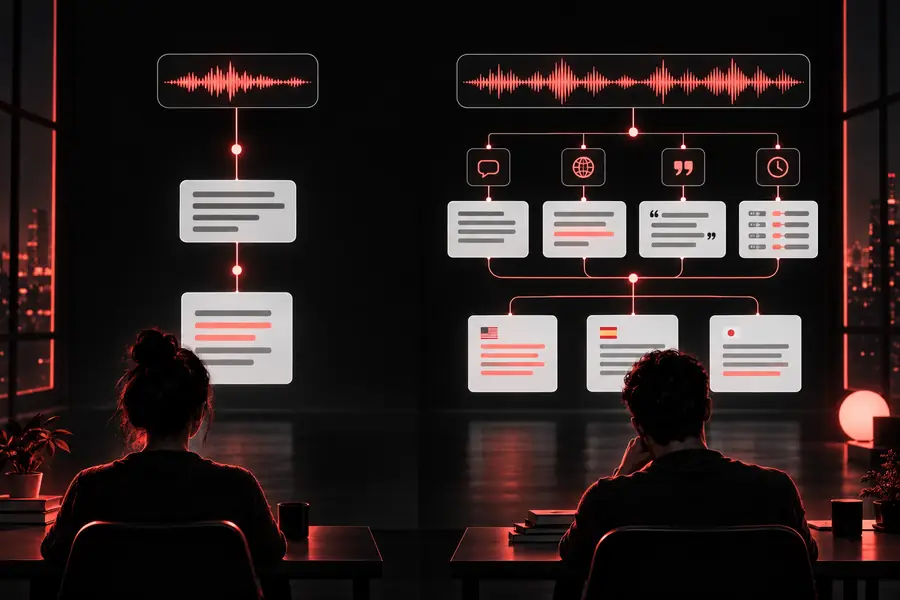
Comparison of Whisper and Transcribe speech recognition workflows

Related comparisons

Compare adjacent speech-to-text routes

The best choice changes with your latency, hosting, and alignment requirements. These related comparisons help narrow the field.

Fit by workflow

Who each option suits

Neither engine wins every category. Your audio source, infrastructure, and tolerance for maintenance should determine the pick.

Privacy-conscious researchers

You record interviews, field notes, or internal conversations and want audio to remain inside your own environment.

Whisper is usually the stronger starting point because you can run the model locally and control storage, access, and processing.

whisper alternatives open source

Product teams shipping an API

Your application needs managed ingestion, predictable service operations, and a clear path from prototype to cloud deployment.

Amazon Transcribe can reduce infrastructure work, especially when AWS integration, managed security controls, and service administration matter most.

whisper vs deepgram

Editors needing aligned text

You need timestamps, speaker separation, or word-level alignment for subtitles, searchable media, or post-production.

Start with Whisper for the transcript, then evaluate an alignment layer or WhisperX-style workflow rather than assuming either base engine solves every downstream task.

what are the key differences between whisper and whisperx

Migration path

Move from one transcription route to another

A controlled migration preserves your evaluation set and exposes the differences that matter in production, not just on a clean sample.

  1. 1

    Define the baseline

    Collect representative recordings across accents, background noise, speakers, microphone types, and vocabulary. Keep the original audio and measure more than word error rate: punctuation, names, timestamps, and turnaround matter too.

  2. 2

    Run both paths

    Send the same files through Whisper and Transcribe with comparable language and formatting settings. Log processing time, failures, manual corrections, data movement, and the engineering effort required to operate each route.

  3. 3

    Switch by workload

    Move one workload at a time, retain a fallback during review, and route sensitive or unusual audio to the engine that performs best. Re-test after model, SDK, or service changes.

Decision table

Verdict: Whisper vs Transcribe

Whisper is a model you can control; Amazon Transcribe is a managed service you consume. That distinction drives most of the practical trade-offs.

Whisper
Amazon Transcribe

Deployment

Whisper

Run locally, on your own servers, or in infrastructure you control.

Amazon Transcribe

Use a managed AWS service through APIs, consoles, and supported integrations.

Operational work

Whisper

You manage inference, scaling, packaging, monitoring, and upgrades.

Amazon Transcribe

AWS manages the service layer; your team still configures access, jobs, storage, and integrations.

Privacy control

Whisper

Audio can stay within your chosen environment when deployed locally.

Amazon Transcribe

Audio and transcripts move through a cloud service under your AWS configuration and retention policies.

Language breadth

Whisper

Broad multilingual coverage, with transcription and translation capabilities.

Amazon Transcribe

Language availability depends on the Transcribe feature and supported language list for your region.

Real-time use

Whisper

Possible with an appropriate streaming wrapper and suitable infrastructure.

Amazon Transcribe

Managed streaming options are available for applications that need live transcription.

Customization

Whisper

You can choose model size, decoding settings, hardware, and surrounding processing.

Amazon Transcribe

You work within the controls, vocabulary features, and service behavior exposed by AWS.

Scaling

Whisper

Flexible but dependent on your queueing, hardware, concurrency, and deployment design.

Amazon Transcribe

Convenient cloud scaling, subject to service quotas, regional availability, and account configuration.

Best default

Whisper

Private archives, experiments, offline processing, and teams that value control.

Amazon Transcribe

Production applications that prioritize managed operations and AWS-native integration.

Useful scale facts

The numbers behind the choice

These model characteristics explain why Whisper appeals to some teams while a managed service appeals to others.

Whisper model sizes let teams trade accuracy, memory, and processing speed.
5 sizes
Whisper's broad language coverage supports multilingual archives and mixed-language projects.
99+ languages
Whisper supports speech transcription and speech translation to English.
2 tasks
Whisper processes audio in short windows internally, so long files need a thoughtful pipeline.
30 seconds

Honest caveats

What this comparison cannot decide for you

A feature list is not a production test. These limitations are where a small evaluation set becomes essential.

It cannot predict your error rate

Accent, overlap, room noise, jargon, microphones, and speaking style can change results more than the product name suggests.

Workaround

Build a labeled sample from your own recordings and review names, numbers, punctuation, and speaker turns separately.

It cannot make local Whisper maintenance disappear

Running a model yourself still means handling compute, queues, retries, observability, security updates, and model packaging.

Workaround

Use a managed inference layer or a narrow batch workflow before committing to a full self-hosted platform.

It cannot guarantee live performance

A strong batch transcript does not automatically provide low latency, stable partial results, or production-grade streaming behavior.

Workaround

Test streaming with realistic concurrency and measure first-token latency, revision behavior, and recovery after dropped connections.

It cannot replace downstream design

Neither base choice alone solves every need for diarization, word alignment, subtitle timing, redaction, search, or human review.

Workaround

Define the complete transcript pipeline and evaluate each post-processing stage with the same test recordings.

Choose with evidence

Put both transcription routes through your real workload

Start with a small set of representative recordings, compare corrected transcripts and operating effort, then choose the route that fits your privacy, latency, and maintenance constraints. A practical test is more reliable than a generic winner.

Test your audio
  • Compare the same files
  • Check privacy and hosting needs
  • Measure correction effort
  • Keep a fallback during migration

Comparison FAQ

Whisper vs Transcribe questions

Use the comparison as a decision framework, then validate the choice against the recordings and constraints that define your project.

Whisper is a speech recognition model that you can run and integrate under your own control. Amazon Transcribe is a managed cloud transcription service, so the main difference is model ownership and infrastructure responsibility rather than transcription alone.

There is no universal winner because accuracy changes with language, accent, noise, vocabulary, microphone quality, and configuration. Compare both systems on representative recordings from your own workload instead of relying on a general ranking.

Whisper can be better for privacy when you run it locally or inside infrastructure you control, because audio does not need to leave that environment. Transcribe may still fit organizations with approved AWS controls, but its data path and retention settings require careful review.

Transcribe is usually easier when you want a managed service and already operate in AWS. Whisper offers more control and deployment flexibility, but your team must design scaling, monitoring, hardware allocation, queues, and upgrades.

Both can support real-time use, but the implementation model differs. Transcribe provides managed streaming interfaces, while Whisper needs a streaming wrapper and infrastructure designed for incremental audio, latency, concurrency, and reconnect behavior.

Choose Whisper when local control, multilingual coverage, customization, or offline processing is central to the project. Choose Transcribe when managed operations, AWS integration, and a service-based deployment matter more, then confirm the decision with a side-by-side test.

Start transcribing
Start transcribing